

 The town of Pea Ridge and the Pea Ridge National Battlefield Park sit a few miles south of the Arkansas-Missouri border. The farmland on which the three-day reenactment was fought lies splat on top of the state line. I think our cars were parked in Arkansas and we fought in Missouri. The site was large enough for two battlefields and a sutler row that wasn’t too close or too far from either the Yank or Reb campgrounds. The basics of portacans, firewood, water and hay seemed well-covered and weren’t an issue. The weather was delightful, cool to cold at night and pleasant to warm during the battle times, and no rain.
I did see one activity that is often threatened by well-meaning event management, but Pea Ridge was the first time I’ve seen it done. We watched two cars that were parked on the edge of the Confederate camp towed away on Saturday morning shortly before the public battle. Hoorah! It was one of the prettiest sights I’ve seen. It was like spotting a rare bird. I hope the cars’ owners, who were either incredibly lazy or thought rules don’t really apply to them, were aghast when they realized what had happened to their wheels. Again, Hoorah! Thank you, Management.
Sutler Row included three general sutlers-Rum Creek, Fall Creek, and James County, a well-known hatter—Clear Water Hats, and several other product specific sutlers. I didn’t see any modern food and kettle-corn type vendors. One sutler was selling a popular — well, popular in our company camp since two of us bought the new “oversized” folding canvas camp stool, made especially for “artillery-sized butts.” We’re infantry, not artillery, but the new stools were indeed wider, more stable, and more comfortable than the standard canvas folding stools that sutlers normally stock. Thank you, Rum Creek Sutlery.
There was a small drone flying above the Confederate camp one day and during at least one battle. I didn’t notice it during the fighting, but I did look up right before Saturday’s battle to see two jet vapor trails that crossed nicely and I imagine, intentionally, in the blue sky above us. We all assumed the crossed white contrails were someone’s vote supporting the Rebel battle flag. Nicely done, whoever was responsible for the symbol in the sky.
Two groups of reenactors, one blue and one gray, marched nine miles on Friday from the National Park to the reenactment site, arriving shortly before the afternoon spectator battle. I applaud the men who organized and took part in those marches. It’s a growing facet of the campaigner side of the hobby, and seems a great way to merge into large mainstream reenactments the campaigners’ interest in camping light and experiencing the rigors of marching infantrymen. I’ve seen similar marches at Bentonville, N.C. earlier this year and at Shiloh, Tenn., and Antietam, Md. in 2012.
There was a civilian tent city in the middle of the main battlefield, around which the Saturday and Sunday spectator battles were fought. From my place in our battalion column, I counted five Confederate infantry battalions and four Union infantry battalions. The Rebs had a line of eight cannons and the Federals had perhaps four artillery pieces. There were two horse-drawn cannons moving around the field, a sight that is always welcome, and there were a few period wagons added to the mix. There were no ice angels that I saw, at least. Thank you again, Management.
There was a dance, but I’m too old and too footsore by Saturday night to care. There was also an unplanned stupid night engagement around midnight. Sadly, it included two Rebel artillery crews who moved their cannons to the edge of camp, just yards from our battalion camp of sleeping men, and blasted away into the dark field separating our camps. A bunch of infantry joined the nonsense. The cannon blasts woke me up and the rifle fire was like a bunch pesky mosquitos, but it ended soon enough. I regret that the event management, which did so well in all other areas, let that sort of dangerous stupidity occur. On the other hand, I’m not sure how management could have prevented “spontaneous” and likely drunken decisions by a bunch of big little boys to go play in the dark without adult supervision.
As Rebs, our battalion fought going down slope both Saturday and Sunday. We were the rightmost battalion in the brigade line and we were well engaged. After the cannons dueled, we contracted our battleline into five company columns and passed through the gaps between the cannons. We did our duty to hold the 20 or so Union cavalrymen at bay out on the flank.
But we could not prevent those cavalrymen from charging the end-most Reb cannon while it was unloaded and “capturing” it. I guess our battalion of 90 rifles was invisible, as the mounted boys in blue ignored our supporting volleys from 30 yards away, not to mention the grapeshot that would have turned their horse flesh to horse mush in a real mounted charge on a cannon battery. But, I concede there is little else for the mounted arm to do during our spectator battles. Moreover, our battle fields rarely have adequate space for cavalry to appropriately maneuver, and a line of 20 charging cavalry is impressive in appearance.
Our battalion spent quite a while engaged with the Union infantry, trading volleys and advancing and retiring. Personally, both days, I emptied the top of my cartridge box, firing about 30 rounds each day, then took a hit.
On Saturday, while I was lying “dead” on the ground with my hat shielding my face from the sun, arms and legs all akimbo in my death throes, I heard a very twangy loud Southern voice saying, “Y’all lie still now, you hear. Lie still and you won’t get stepped on.” Then I saw horse legs, up close, and big wheels turning. It was a wagon and an artillery caisson creaking by, following our advancing battleline. I lay still as a stick after I pulled in my arms and legs, and, sure enough, I wasn’t stepped on. Thank you, Mr. Teamster.
Before dying for the cause, and still in the fighting formation of our company, I was between two teenagers from Austin, Texas, who were experiencing their first reenactment. They did well and appeared to have a fine time, even if grandpa was stuck between them. When our battalion charged and almost all of us let loose our Rebel Yell, the youngsters didn’t immediately cut loose hollering. So, I put a little extra into my deep-throated barking dog yelps to model for them. The young lads cut me a glance, then joined in.
On Sunday when we first marched towards the Yanks, elbow to elbow, cannons firing at us, I offered a repetitious prayerful mantra loud enough for the armed boys around me to hear: “I am not afraid. I am not afraid. I am not afraid.” I caught them both looking sidelong at me, probably thinking, “You are one crazy old coot.” I loved it.
We were teenage boys and bearded gray-haired men, the pride of the South, marching forward. We embodied the spirit of the card stuck in our colonel’s hatband, on which was boldly printed, “I Will Not Be Subjugated!”
I suppose Pea Ridge is starting a new cycle of large regional early war reenactments. Those of us who live in the Trans-Mississippi theater of the war welcome such events as Pea Ridge. If good people keep putting together well-planned and well-executed events like Pea Ridge was last September, our fine hobby will keep rolling along for years to come. I’m really glad I attended.
As a last thought, if you enjoy my articles in the Camp Chase Gazette, please check out the Civil War-related essays which I post weekly on McBride’s Civil War Novels, my blog on Google’s Blogspot on the web.
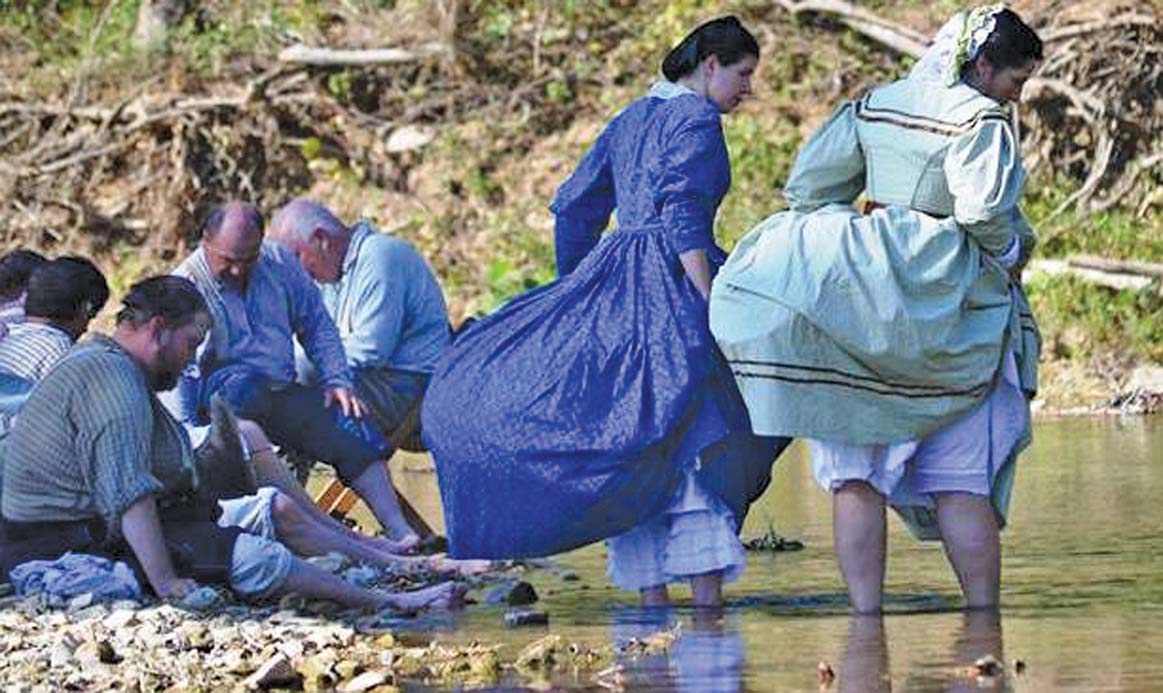
All the photos illustrating this article are from the eye and camera of Stephanie Ford, a fine reenactor and photographer from Corsicana, Texas.
-By Philip McBride