Featured
Articles
BY
THE THOUSANDS WE CAME
The Hunley Funeral
By William Waldrop
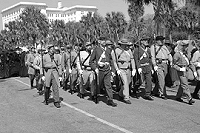 |
By
the thousands we came, from every corner of south,
reenactors on our way to Charleston for the burial
of the Hunley crew. Many other accents were heard
this day as well, Northern, Western and even European.
We were also a very diverse group economically. Doctors,
lawyers, politicians, firemen, electricians, sheet
metal workers, accountants and brick masons, just
to name a few. People wealthy enough to fly across
the ocean for the weekend as well as the less fortunate
guy with rough hands and an |
even rougherlooking truck who hoped he would have enough
money and duct tape to make it back home.We were there for
many different reasons as well. Some came because they grew
up listening to bedtime stories about the bravery of these
eight men. A tale passed from father to son for generations.
Others came for the spectacle itself. It's not everyday
the Confederate Army marches through Charleston. Others
were there to attend what was being called the last Confederate
burial. The majority of us I believe, were there to honor
in the only way we knew how, these eight brave men who gave
their last full measure in an attempt to break the stranglehold
of the Union naval blockade and in the process, made naval
history and disappeared into legend.
Our
day began around 6 AM. The fog was hanging low over the
salt marsh behind our encampment at the Charleston Rifle
Club and we knew today was going to be a warm one. The
weather forecast was calling for the temperature to be
around 82 degrees. Any temperature in the 80's is uncomfortable
for reenactors. Our hosts at the Rifle Club, who had treated
us like visiting royalty all weekend, had risen even earlier
than us and prepared breakfast and bag lunches for us.
We quickly wolfed down our breakfast and then put on our
wool jackets, fastening every button up to the collar.
Next our leather cartridge box, belt and bayonet. On our
opposite hip we slung our haversack, threw in a sandwich
and bag of cookies. Over this went our canteen with its
lifesaving water. We made sure our stiff leather brogans
had been tied securely. Grabbing our muskets, we began
the relatively short walk to the large assembly area in
North Charleston where we were to board buses.
As
we arrived, I was struck by the sight of an endless line
of buses on the side of the road pointed our way. The
reenactors coming from every direction, gathered all around
in every state of disarray, some still receiving help
getting their equipment on. The scene reminded me of photographs
taken of the men of the 82nd Airborne preparing to load
into the airplanes, which would drop them into occupied
Normandy on June 6th 1944. Like them, we knew we would
be making history today. We were also uncertain what the
day would bring. There was a very visible police presence
and we all had heard rumors that there might be trouble.
Threats had been made against state Senator Glenn McConnell,
and even the coffins carrying the remains of the crew.
That was the rumor anyway. There the similarities with
the 82nd ended. We were going to participate in a funeral;
too many of them went to their own.
After
we had loaded onto the bus and headed on our way downtown,
I looked over at my son who was now 16 years old. This
was to be his first event and I had wondered how this
boy, who in the past couldn't bear to be thirsty and who
had always complained about long walks, would hold up
on this five-mile march.
Many
of us were wondering how thousands of reenactors were
going to converge on White Point Gardens, commonly called
the "Battery" in what was sure to be absolute chaos with
no command structure that we were aware of and be expected
to form up into ranks for the long march. Once again the
rumor mill had it as being 20,000 reenactors and 30,000
spectators. We arrived at our destination around 8 AM
and it was just as we had imagined. Absolute chaos. Spectators,
civilian reenactors with their stovepipe hats, female
reenactors in their black mourning clothes, their faces
hidden by black veils, Confederate soldiers everywhere
and surprisingly some Yankee soldiers. All mixed together
in a multi colored sea of humanity. Everyone seemingly
asking for directions. "Where do we register? Where are
the Daughters of the Confederacy? Where do I get my black
arm band? Anybody seen the 11th Virginia? For God sakes,
where are the porta potties?"
Most
reenactors are used to drilling, marches and "forming
up". Over the years they have met so many other reenactors,
they can always find a company that they can fall in with.
"Hey Johnny! How ya been buddy? Haven't seen you since
the 130th at Antietam. Are you by yourself? Well fall
in pal, we can use another man." And so it went, by ones,
two and by the dozens we began to fall in with people
we hardly knew. I would guess that within 45 minutes we
had formed up and were waiting for the march. "Hurry up
and wait" is what you hear from most veterans when they
describe their real military experiences. It was no different
this morning. Standing in formation will wear you down
just as fast as any march. You feel it first in your feet,
then it moves up to your knees, that canteen full of water
begins to make its presence known. Some clown in the ranks,
commenting on some passing dandified officer or curvaceous
spectator always breaks up the monotony of the long wait.
Our attention was also drawn to a large sailboat just
offshore, flying a huge Confederate flag at half-mast.
Also patrolling were several police boats, one in particular
had a machine gun on its bow. We were beginning to wonder
if the rumors we had been hearing were more than rumors.
At
long last someone got on the PA and announced the order
of march. I could not believe all of the various groups
that were to be in the procession, each being assigned
their place in line. Veteran Submariners, descendants
and relatives of the men we were burying, ladies in mourning,
the Sons of Confederate Veterans, reenactors, United Daughters
of the Confederacy, Confederate Order of the Rose, the
Masons, Sons of Union Veterans, Union reenactors and many
more whose names I cannot recall. The Union reenactors
were there to honor the crew from the U.S.S. Housatonic,
the Union vessel sunk by the Hunley. Bringing up the rear
of the whole procession was the Heritage Motorcycle Club.
Now it was time for all the speakers; politicians, preachers,
poets and singers, eulogy upon eulogy, all making their
best effort to honor the eight men whose flag draped coffins
lay before them. To me the most touching of all, was the
gentleman who sang a ballad he wrote entitled, "Hunley
Shine On." I had never heard it before and looking all
around, I saw many of my fellow reenactors choking back
emotion as best they could. No one ordered us not to cheer,
it was just understood this was a funeral. Respect was
the order of the day. Even so, there were quite a few
Rebel Yells after the song ended.
In
time, the microphone grew silent and the horse drawn caissons
began to pull out with the eight coffins firmly affixed
to them. Soon, the order was given by our captain to "Fix
bayonets!" and then, "Attention! Shoulder Arms! Right
Face!" We were now standing four abreast with our index
finger under the trigger guard, our other three fingers
behind the hammer and the barrel against our right shoulder.
Probably the most uncomfortable way to carry a musket
for any length of time. The column ahead of us began to
move and we finally were given the command, "Forward�..
March!" More than two hours had passed since we arrived.
At long last we were off, left... left... left, right,
left. Everyone in lockstep, the drums beating out the
cadence. Now you could hear the tramp, tramp, tramp of
thousands of steel heeled brogans keeping time with the
drums. Passing reporters held their microphones near the
ground to capture the sound. Our column moved up to where
the openness of the "Battery" gave way to the narrow streets
lined on both sides by fine old homes, with their broad
porticoes and long spacious piazza's. We could see that
they were spilling over with people waving, and holding
flags, which draped over the railings. The people lining
the streets below all seemed to be waving something; their
hands, small flags on sticks and even handkerchiefs. Fathers
held their small children up on their shoulders so they
could see above the crowd. Many of those spectators had
tears streaming down their face. Whether it was from the
solemnity of the occasion, the drums and fifes, the sight
of thousands of bayonets shining in the sun, the sound
of our shoes stamping in unison or a lack of port-a- potties,
you would have to be a pretty hard person not to be moved
by the spectacle of it all.
Sensual
overload is the only way I could describe what I was experiencing.
As a reenactor on the march, you have to be completely
focused on staying in step and in formation. This to some
degree gives us "tunnel vision." You really don't have
time to take in all that is going on around you. The sights
and sounds you retain are all little vignettes captured
here and there by your memory. I have no idea how many
reenactors were there or spectators, how many flags were
being flown or the racial makeup of the crowd. We were
somewhere near the middle of the procession and on the
rare occasions when we stopped, I stepped out of line
and looked up and down East Bay Street which is a very
long and straight stretch. What an impressive sight, as
far as I could see in both directions there was an endless
column of reenactors. No two uniforms exactly the same,
hats of every description and color, all of us wearing
white gloves and a black armband. An unforgettable sight,
the only thing going on which irritated most of us was
the infernal helicopter circling overhead and a lone plane
towing a banner with a Confederate flag on it, followed
by "Dump Bailey." Even at a funeral, someone has to insert
politics.
The
horse drawn caissons ahead were now leaving souvenirs
behind. Have you ever been in a parade or march behind
teams of horses? It's amazing what they can do to a perfectly
clean street and how often. The company wise guy had something
to say about that too. "Hey y'all, watch out back there.
Yankee brains in the road ahead!" We'd heard it all before,
in fact our Northern brethren say the same about us.
As
the blocks began to turn into miles, the sun rose higher
in a clear Carolina Blue umbrella sky. If there was any
wind, we couldn't feel it. The heat, weight of our musket
and the uncomfortable way in which we had to carry it
were beginning to tell on us. I kept looking over my shoulder
at my son, hoping he would not say, "Dad, I can't take
it any more." He looked tired and strain was showing on
his face but he never uttered a word of complaint. To
add to our discomfort, the whole procession was a march.
Typically when we are in a parade or long march we eventually
go into what is called a "route step". You don't have
to keep time with the drummer or move your left and right
feet in unison. Since this was a funeral we were required
to march the whole way in unison. It looked good, sounded
good but sure wore us out. Periodically, the captain would
order us to change the position in which we carried our
musket. Company! Support Arms! A little while later, Company!
Right shoulder shift! And then back to Company! Shoulder
Arms. Each time we changed positions the musket seemed
to get just a little heavier. And so it went, mile after
mile.
By
the time we reached the Route 17 bridge, which was a little
more than half way, the scenery was beginning to change.
No longer were we surrounded by beautiful mansions and
people who looked to be on vacation, we were now in working
class neighborhoods and industrial areas. The streets
were still lined with people, many of them offering cold
water, some snack to munch on, or just encouragement.
"What State you from? Looking good guys! Come on, you
can do it!" One man was holding what he claimed was the
flag used during the filming of the TNT movie about the
Hunley starring Armand Assante as Captain Dixon. Some
men broke ranks to touch it and some I'm told even kissed
it. Another gentleman held a rather large portrait of
General Lee. As the ranks passed it, the men spontaneously
turned their heads toward the portrait and saluted as
though passing in revue.
Another
mile gone by, we now were very hot and very tired. Our
right arms were beginning to feel several inches longer
than our left arms. The canteens, which were slowly headed
towards empty, magically seemed to maintain their same
weight. Our feet now felt like stumps on the ends of our
legs. We could see an overpass ahead lined with construction
workers who had stopped their labors to watch us pass.
It was like seeing an oasis in the distance. For there,
under it was shade, wonderful shade. All too soon we were
back into the sun.
The
surrounding area had once again changed. People were still
lined up along the road but for the most part they seemed
frozen in place as though they were caught in the middle
of something and stopped just briefly to see what was
going on. Many were not smiling, I'm sure some of them
probably didn't like us or what we were wearing but I
never heard an angry word or saw an ugly gesture. Neither
did anyone else that I talked to. I only have one thing
to say to them. Thank you. Thank you for letting us pass
in peace to bury eight men who are heroes and legends
to us.
We
were exhausted by now; some of the men were beginning
to feel light headed and nauseous. Many faces were red
as beets. Looking over my shoulder at my son, I found
he was still hanging in there. Looking pained and his
face covered with sweat. When I asked how he was, he said,
"I can make it dad." I was beginning to wonder if I could.
Even the drummer was beginning to sound less than enthusiastic.
I
saw a sign up ahead. What did it say? It was green, I
could tell that much but what did it say? Magnolia Cemetery!
We had made it! I looked back at my son; his face broke
into a smile, proud that he had endured. I was proud too!
It's amazing the shot of adrenaline you get when you see
the finish line. The Captain barked, "Step it up boys!
Make me proud." The drummer picked up his tempo and we
found new energy as we put a little more tramp into our
tramping.
Little
did we know that our discomfort was not yet over. The
road leading into the cemetery was once again lined with
spectators two and three deep. The closer we got to the
gates of the cemetery the more crowded it became. The
column, which had been moving at a constant pace, was
now start and stop. Before us was a sea of heads, we were
beginning to wonder if we would even get near the grave
site. Eventually the crowd moved aside and we began to
make a turtles pace towards a raised platform in the middle
of an open area of the cemetery. On it were the flag draped
wooden coffins of the crewman and a podium with several
chairs alongside. A collective groan went out from the
ranks, Oh no! More speeches! As we made our serpentine
way towards our final destination, we saw the line ahead
of us bend to the right and some men broke rank. As we
got closer, we saw why. The ladies in black mourning clothes
had set up a long table and were serving ice-cold lemonade
and cookies. I haven't seen Confederates charge like that
since Gettysburg. God bless those women! The lemonade
and cookies gave us the last bit of energy we needed to
see it through. Quickly order was restored, and we wound
our way to our position behind the stage. Out front, in
a semi circle of steel chairs sat all the V.I.P's. Among
the Senators, state Representatives, and other dignitaries,
I saw Clive Cussler who had been given an honorary position
in the front row, somewhere near center of the stage.
A very distinguished looking, well tanned gentleman with
sunglasses, wearing a black suit. His snow white hair
blown by a heaven sent breeze.
Finally
the last ceremony began; once again there were many speakers
and a singer, whose voice and song, accompanied by several
musicians, touched us all. I suddenly recognized the singer
as one of our new friends from the Charleston Rifle Club.
Several state Representatives were recognized for their
support, the bulk of the praise going to Senator McConnell
who helped iron out all the bureaucratic roadblocks in
Washington. Each in turn stood to be recognized. Senator
McConnell took the podium and gave Mr. Cussler all due
credit for being the man who had the vision, took the
time, made the effort and spent his own money, to locate
what was in effect a needle in a haystack. Curiously,
he was not asked to stand and be recognized. We found
out later that it was because threats had been made on
his life as well.
After
what seemed like an eternity to us, the speeches ended
and the pallbearers stepped forward to carry the crewmen
to their final resting place. We were ordered to form
up and move out. For us it was over, we had done our duty
and escorted those brave eight men who had at long last
received the honors and proper burial they so richly deserved.
You may not agree with their cause, you may just think
they were a bunch of stupid fools. I would challenge you
to go to Charleston one day and visit the museum, which
will house this little sub. They have a full scale mock
up of the Hunley for you to go in. Climb into that four
foot tall hull, sit on the narrow bench, put the crank
in your hands, look around and ask yourself if you would
have taken a ride submerged in her on a dark February
night on the open ocean, with only a small compass and
the moon to guide you, knowing that two full crews before
you, had drowned in her. Would you be willing to risk
it all for any cause?
We
were on our last march together, all of us relieved that
it was over and we had been able to make it. When it had
begun hours before we hardly knew one another. We now
had a common bond forged by the heat and torment of the
march, the experiences along the way and the periods of
laughter, which the company wise guy had provided. Once
again I looked over at my son, along with the sweat running
down his flushed face was a look of accomplishment. He
had stood the test. I hugged him, told him I was proud
of him and realized I could never again call him "boy."
We
broke ranks and said our good-byes, wished one another
well and told the Captain it had been an honor to march
with him. We would meet again at some future place and
time and the greeting would once again be, Hey Johnny!
How ya been buddy? Haven't seen you since the Funeral!
Bill Waldrop, eyewitness to history.
RIDGEPOLE
RUMINATIONS
April
2004
By
Bill Holschuh
I�ve
always felt that my job as publisher of Camp Chase Gazette
and The Citizens� Companion ultimately boils down to two
basic tasks: Try to figure out exactly what our readers
want, and then give it to them. Up until several years
ago, based on a fairly decent track record, I thought
I had a pretty good handle on my job. Lately I�ve not
been so sure about that, and I think I know why.
Fifteen
years ago this fall, fellow reenactor Grant MacMeans and
I were negotiating with CCG founder Bill Keitz to buy
Camp Chase Publishing Co. In the course of one of those
conversations, we asked Bill what events he had attended
that year (1989). He informed us that his last event was
125th Gettysburg in July 1988!
We
couldn�t believe our ears. How could the founder/publisher/editor
of Camp Chase Gazette go fourteen months without attending
one single reenacting event? Right then and there we vowed
that if we were ultimately successful in buying Bill out,
(and obviously we were) we would never allow ourselves
to be that out of touch with what was going on out there.
Although
my current participation level is still more frequent
than one event in fourteen months, it certainly isn�t
what it once was either. And more important than how often
I go is the fact that when I do go, I consider it a chore.
Oh, I still get a rush when I see a great looking brigade
or battalion march by (Rambo�s at 140th Perryville comes
to mind). And I still enjoy reconnecting with the many
friends I have made in the hobby over the years. But when
I�m really being honest with myself, I have to admit that
I just don�t have the reenacting bug any more.
So
my decision to sell Camp Chase Publishing to Lakeway Publishers,
Inc. really came down to nothing more than just keeping
the pledge that Grant MacMeans and I made way back in
1989. To do this job right, you have to have your very
heart soul in Civil War reenacting, and I don�t. That
fire has burned itself out, and now it is time to move
on.
Camp Chase Gazette seems to have a charmed life. Against
all odds, it has survived for 32 years because it has
always received exactly what it needed, exactly when it
needed it. Several times Bill Keitz almost threw in the
towel in the early years, but then a financial windfall
of some sort would save the day. In 1989 it needed the
skills that Grant and I brought to it. And now, in 2004,
it needs the financial stability and marketing expertise
that have arrived in the form of Lakeway Publishers and
CCG�s new publisher, Mr. C. Reece Sexton. I have no doubt
that Reece and the other good folks at Lakeway (owners
of the The Civil War Courier and a number of other publications)
will provide the energy and resources necessary to take
Camp Chase Gazette and The Citizens� Companion to new
levels of accomplishment and excellent service to the
hobby.
There
are many, many people to whom I am deeply indebted, and
only space enough here to mention but a few. The others
I�ll be thanking by phone and letter in the days ahead,
but there are several names that I must mention here.
From
the early years, a heartfelt thanks to my friend, business
partner, and my first editor(1990-1996), Grant MacMeans.
He made this gig a lot more fun than anyone should be
allowed to have at work. We were a great team, and it
was never quite as enjoyable to do this magazine or attend
reenacting events after Grant departed.
And
a huge thanks to Bill Jackson, (associate editor, 1990-1996
and editor, 1997-2002) who offered his journalistic talent
and experience to a clueless salesman and an anal-retentive
accountant who foolishly thought they knew how to put
out a magazine. Without Bill in our corner, we would have
never had the nerve to take on this madness in the first
place.
Thanks
also to Denise Thacker, the always-cheerful voice you
hear when you call our office. For the past six years
she has been my right hand, and the best, most loyal assistant
anyone has ever had. She does so many things so well,
and always makes it look easy.
I
have known our current editor, Nicky Hughes, for a long
time, but only worked with him for the past two years.
That experience has made me wish our professional association
had been much longer. I hate to use a tired old clich�,
but there are no other words that describe him as well:
Nicky Hughes really is a gentleman and a scholar.
Brady
Peery joined us two years ago as our art director. His
many talents have brought beauty and style to CCG, and
he has developed a great eye for capturing reenactors
at their best on film. He definitely does have the reenacting
bug, and I hope he has as much fun being infected with
it as I did.
Last,
but far from least, Susan Hughes has been simply magnificent
as the first and only editor in the ten-year history of
The Citizens� Companion. I can say with absolute certainty
that no one else could have done the job as well. But
as valuable as she has been to me in that role, she has
been even more important as a dear, personal friend.
In
my very first column in January 1990 I said that no matter
what the legal documents may say, Camp Chase Publishing
really belongs to the men and women of the Civil War reenacting
community. That�s still true today.
So
goodbye y�all. And for God�s sake, start being nicer to
each other!
TACTICAL
ADVANCED GUARD
A Southern Private's Recollections & Reflections
By Phil McBride
The
Tactical Advanced Guard (TAG) event took place on a beautiful
weekend in mid-October in Stewart County, Tennessee. Stewart
County is on the Tennessee-Kentucky border and is the
site of Fort Donelson of Civil War fame, and Fort Campbell
of the modern army. The event was sponsored by the Western
Independent Grays (WIG) and promoted on the Authentic
Campaigner website discussion board. The openly-stated
goal of the event was to bring together the most dedicated,
campaign-oriented reenactors in the country for a 48 hour
immersion where there would be no sutlers, no spectators,
no modern distractions, no porta-cans, and no printed
schedule of activities. Additionally, a $20 donation for
preservation efforts at the Franklin, Tennessee battlefield
was collected as each man checked in. (At least two men
brought in donations of $500 each and a total of about
$7,000 was raised.)
There
was to be an inspection of each participant's kit to ensure
no one brought anachronisms like cameras, non-period snacks
or smokes, or anything else not available to soldiers
in 1862. Uniform and gear requirements were specific,
but left enough latitude for almost anyone to round up
appropriate stuff. The organizers made it clear that first
person, nineteenth century conversation was expected throughout
the weekend. In other words, forget the twenty-first century
from noon Friday until noon Sunday, and just don't talk
about sports, jobs, cars, or modern war.
The
event promised to be strenuous, with all participants
walking or horse riding into the 1200 acre site, sleeping
under the stars and clouds, and eating rations provided
by the organizers. Activities would not necessarily include
pitched battles between the two battalions, but would
focus on probing, skirmishing, and picket duty.
All
the above was promised by the organizers and expected
of all participants. What was actually provided by the
leadership and performed by the men was both less and
more. The logistics were pulled together by Joe Smotherman,
Pat Craddock, and other WIG members, and they were superb.
Several large plastic water tanks, covered with wooden
planks, were strategically placed around the site. The
rations issued to we southerners were healthy, appropriate,
and plentiful. The food was cached before the event in
period boxes and sacks, and issued by company on Friday
afternoon. Haversacks were stuffed and slowly emptied
through the weekend.
Dom
Del Bello commanded the Federal battalion and Pat Craddock
led the Confederate battalion. Each battalion was comprised
of four companies of about 25 rifles in each. Some seventeen
cavalrymen of the Critter Company were led by Coley Adair,
and about fifteen Federal cavalry supported the Northern
infantry. The Rebel battalion was further supported by
a medical officer, in the person of Nicky Hughes, the
editor of this periodical, and Tom Smith, a cartographer
whose eye for terrain and talent with a pen proved more
and more valuable as the two days progressed.
The
site was perfect. The acreage was comprised of rolling
hills with interwoven meadows and forests. Three small
ponds, a couple of log cabins and old barns, a meandering
creek, and a few dirt roads through the property created
a landscape that was ideal. A group of civilian men, ladies
and children soon occupied a log cabin nestled on the
creek.
The
event certainly had an impact on the participants. As
of today, nearly three weeks after we hiked out and drove
home, there have been 118 messages about TAG posted on
the Authentic Campaigner website forum, and over 7,000
hits have been made on the after-action message threads
by those wanting to read what others thought about the
event. I suspect most of those hits were made by the 250+
participants, and that alone makes the event worth a little
reflection. Was TAG a benchmark event? Does Civil War
reenacting need these types of events? Is a significant
portion of the hobby slowly, I mean s-l-o-w-l-y like cold
molasses, moving in the direction TAG took? Were the shortcomings
of TAG really a problem? Were the highlights of TAG really
that good, and were they replicable at future events?
Those are fun questions, mainly with answers as varied
as the guys offering their opinions on the website forums.
I
was not a part of the TAG planning or leadership team.
My role was that of a private who had all I could handle
just keeping up with the young flat-bellied boys and keeping
my smoothbore blowing smoke and going boom most of the
time when I pulled the trigger. I haven't talked with
or written to the big bugs of the event. Therefore, the
remainder of this account is no more than recollections
and observations of the sort that would have been made
by a private in the fall of 1862 in letters sent home.
If
nothing else, reenacting has shown me that Civil War battle
to a private or NCO boiled down in a lesser degree to
his regiment, to a greater degree to his company, and
to a high degree, battle was just him and his squad mates.
TAG exemplified that simple perspective. Throughout the
event, the two opposing battalion commanders often only
linked two or more companies together early in each developing
engagement, until each commander felt he had some idea
what the other was up to. That meant the four companies
repeatedly functioned as independent units, and the companies
often went to skirmish formations.
TAG's
small numbers allowed even we privates to recognize that
our officers were doing a whole lot of guessing about
the enemy's locations and intentions. That meant that
we did a whole lot of marching hither and yon, back and
forth, waiting where the major thought the Yanks might
approach, and then moving yet again to help out where
the bluecoats really did appear. That was the defensive
side of the coin. But, being under the command of a man
who believes in action more than prudent waiting, we took
even more steps, seemingly always uphill at the double
quick, trying to coax the Yanks into a fight. Finally,
the major just tossed caution aside and took the action
to them.
Then
there was the third side, or edge of the coin. That was
the guard duty each rifleman pulled for some six hours
during one of the two long cold nights. I bet every man
finished the event with strong personal moments of time
travel while on guard post.
Personally,
I loved TAG. I was worn out and ground down by the time
we marched to the cars late Sunday morning, but every
aching step was tempered with a satisfaction that this
had been a very good weekend. The big promises of the
organizers had been met, even if some things didn't work
well. Too many guys on both sides refused to take hits.
Most everybody slipped into modern conversation as we
waited through the "down time" in conversation, getting
to know each other. A fair number of men melted away on
Saturday and were AWOL on Sunday. But those shortcomings
were way overshadowed by the remarkably nineteenth century
sights and sounds. You just had to believe when you could
look out on the two dozen Federal campfires across the
valley on a foggy night marking the enemy's forward positions.
You had to believe as you nibbled on period rations for
two days. You had to believe when you stood cold night
guard duty, took part in repeated skirmishes, and felt
the uncertainty of not knowing when things would flare
up next. And you just had to believe when you found a
reflective minute to quietly be aware of the simple absence
of things from this century.
TAG
started by both battalions, one hundred strong in four
companies each, marching a mile or so into the battleground
area about 1 pm on Friday. Our company went directly into
a skirmish line on a steep hill in the woods and spent
a couple of hours holding the hill against two companies
of Yanks who just couldn't decide to come up in force.
We had the mounted "Critter Company" guns to our left
flank helping out some of the time, effectively doubling
our firepower. Our company fought as skirmish partners,
one firing, one loading, as we moved right and left, down
and up, on command of Captain Duffer, another old guy
who has an impetuous streak in him. After a long while
it got nearly dark and the Federals stopped coming up
the hill and we were ordered back to what became our campsite
until Sunday morning.
Saturday
morning started long before dawn, after a cold night in
which two other companies had the picket duty. The major
formed the battalion and we moved down to the same pasture
in the valley where the Yanks had attacked from the afternoon
before. D Company was sent out as skirmishers to our front
in the dim light and fog, as the battalion marched down
the pasture in a column of three companies, first in march
columns, then in battle lines. Then, still in a thick
fog, with shooting and shouting ahead, the three companies
formed a single battleline. We marched on through six
foot high grass in the dawn and fog. Only to never find
the Yanks. The invisible enemy prompted the major to put
us into a defensive posture. Our company was posted in
a flanking skirmish line along the creek and we went prone
for a bit watching, listening, and waiting. We saw blue
coats across the creek and fired at them. We heard cavalry
noises and put bayonets on our weapons, prepared to form
our little four-man squares to defend against a cavalry
charge that might occur. That was another period moment,
being in a skirmish line, on the flank in the fog, hearing
the sounds of horse hooves, but not being able to see
them. The blue force never crossed the creek and we finally
marched back to our camp on the hilltop.
Early
Saturday afternoon after sitting around for a good spell,
the major ordered the four companies formed again. Our
company was ordered to march down the hill in front, across
the pasture, cross an unseen ford in the creek, and seize
a bridge that was supposed to be a little further down,
past a sharp bend in the creek. Our other three companies
had disappeared on other errands out of sight beyond the
woods on our hillside. Capt Duffer acknowledged this was
a fine rash thing to do with no reconnaissance about the
exact location of the ford or bridge or the whereabouts
of the four Federal infantry companies. He was somewhat
profane and positively bouncing in his enthusiasm.
About
then we saw Yankee skirmishers to our far left flank moving
into the woods where all our gear was left in our abandoned
camp. Captain Duffer sent his young lieutenant and five
men to investigate, with orders to then join us when they
could. Our remaining fifteen rifles headed down a steep
clear hill where we immediately came under fire from skirmishers
to our right front. I was running and panting and trying
to keep my place in the little column. The blue skirmishers
apparently withdrew as we kept running toward them.
We
rounded a bend and were at the creek ford. We splashed
through, going up a wee rise out of the creek. I was in
the front rank and looked up and saw at least a platoon
of blue coats as they put a volley right into our front.
In 1862, in real battle, that would have been it for us.
But, in 2003, we hit the dirt, fired back, and all of
a sudden the blue platoon withdrew to our right front
behind more trees lining the creek as it curved their
way. So we went forward a few yards, then stumbled back
into the creek bed and started shooting at Federals on
the bridge we were supposed to seize. We also had a lot
more blue coats to our front on the other side of the
creek. I suddenly realized that we had attacked their
camp and caught two companies in it, with one more company
to our flank around the bridge. We had been audacious
and now we were outnumbered three to one. Thank you, Major
Craddock. I look forward to prison camp.
But
then, Holy Cow, I looked across their encampment field
and saw our other three companies emerging from the same
creek bed 75 yards away around a bend and charging - chasing
the disordered yanks right into us. It was a beautiful
hammer and anvil, our company being the anvil. We rose
from the creek bed and charged ourselves and thereby aided
in the capture of two of the four Federal companies.
The
last Federal company was behind us on a hill in a defensive
skirmish line and around their supply wagon. So our company
veered left and backwards and attacked them as well. The
battle ended in a stand-off -us prone in the creek bed
shooting and them in the edge of the woods shooting and
their wagon in the field in the middle. Their fourth company
had routed off our six camp guards and both groups were
out of the battle for the Federal camp. At that point
things went well with some fine first person activity
among the captured and their guards, and things went downhill
on the field across the bridge as both sides expressed
heated opinions that lots of guns were going bang-bang,
but nobody was going "I'm dead."
It
was about then that I had a strange moment of realization
that our boss, Major Craddock, had been the wily fox,
and we had "won" the day. While I was aware of the element
of big little boys playing Cowboys and Indians while we
attacked and "fought," I knew I hadn't had so much fun
in a long time. More importantly, in a flash of sudden
understanding of the obvious, I knew that moment could
never have happened in a traditional reenactment or living
history program. It could never have been scripted, and
it was only possible because it was built on the prior
24 hours of marching, probing, skirmishing, bivouacking,being
cold and tired, and generally immersing into 1862. It
wasn't a period moment that could come right out of the
can. It had to have been simmered and stirred and tasted
in small sips for at least 24 hours first.
Even
after the afternoon rush brought on by the attack for
the Federal camp, the most vivid memory to me will always
be Saturday night on Guard Post #19 from 9 pm until midnight
and then again from 3 am until 6 am. By 5 am or so during
our second watch, my vigilant picket comrade was curled
up in his blanket against a barn wall quietly sleeping.
I was sitting hunched over, my blanket up over my head
and shoulders, with the musket across my lap. It was real
cold. We were on a hillside looking down on a small glade
and a dirt road right below us. Beyond the road was a
creek with trees lining it. It was also real foggy with
a half moon. The Yank pickets were just across the creek,
no more than 100 yards away.
In
my state of near sleep, I heard something and looked harder.
Just like in a good war movie, I saw, one, then two, then
three, then four shapes trying to very quietly walk towards
us through the fog in the glade below us. Post #19 was
the end outpost so there weren't any other Rebs on the
flank from which these guys were angling towards us. Our
jobs as pickets if the Yanks came on us in any strength
was to shout, shoot, and skedaddle. Our backs were to
the corner of a barn wall, so we would have to be exposed
in the moonlight if we shot and ran. But, I saw there
were only four moving shadows, so maybe this was a Yankee
scout. I nudged my pard, lifted the musket to my shoulder,
cocked it, and hollered, "Halt, identify yourself!" They
stopped, and the lead shape then began walking towards
me. I shouted, "Stop, give the countersign!" He hesitated
a second and walked further towards us. I shouted, "Stop
or I'm shooting!" He stopped and in an angry whispered
shout, said, "You're supposed to say one advance to give
the countersign! It's 'button.' Now the Federal pickets
know it too!"
He
was right, I had blown the script in my excitement. The
four shapes were a Confederate scouting party who had
moved towards us instead of the creek crossing. Then,
the lead shape continued fussing as he kept walking up,
"Who trained you? You don't know what you're doing." Taken
even more off-guard by this young man's bellicose attitude,
I remained still with my musket pointed generally in their
direction. He kept walking until his chest was against
the muzzle end of my musket which was loaded with 80 grains
of powder, was fully cocked, and a sleep deprived, embarrassed
and nervous old guy's finger on the trigger. "THIS is
where your gun should be pointed when the one walks up."
I moved my musket barrel aside, thinking, well, hell,
I may have fouled up the dialog, but I'm not flagrantly
endangering myself by breaking one of the most basic safety
rules like this guy. I guess we're even. Maybe he was
just as sleep deprived and tired as me. So we chatted
for a minute while I pointed out what was where in the
dark and he said they were going across the creek to probe
the Federal outposts, and when they came back, shoot the
fifth guy, since there were only four in his party. Clever.
They got detected by the Yanks real soon. Both sides fired
in the dark back and forth, the Yank picket called the
Corporal of the Guard to Outpost #4 and our guys came
back after a little bit. That episode bit deeply into
my male pride, and also threw up a red flag about safety,
fatigue, and maybe too much "immersing" into our nineteenth
century adopted characters.
The
last clash of arms came Sunday morning when our company
started as skirmishers on our far left, got chased back
to our camp where we joined the line and held off a determined
uphill frontal charge by the massed Federal companies.
We started that episode like the British at Waterloo,
prone behind the hill crest. Then when the blue line came
close enough, we rose and poured it into them shooting
downhill. Captain Duffer had the company firing in 4 parts
- 1st platoon front rank, then 2nd platoon front rank,
then 1st platoon rear rank, then 2nd platoon rear rank.
This seemed to work just like the triple line of Redcoats
in the movie "Zulu," with time for each group to reload
while the others fired. I thought it an amazingly effective
little tactical idea. Then we headed off through the woods
to our right and into the creek again where we waited
a spell. Finally we crawled out of the creek to a little
rise. There we jumped up and advanced at the double quick
right into the field where we mingled with one blue company,
soon to realize that the conflict had been called.
TAG
ended late Sunday morning with a joint formation and mutual
thanks to the land owner and hoorahs for the organizers
and commanders. I suspect the men in both battalions enjoyed
the chance to just stand and stare across the few yards
at the guys on the other side. I know most of the Federals
were standing at ease with full packs, and their postures
appeared to me to reflect an attitude of men who were
real tired, but secure in their competence and pride.
In other words, they looked like the veterans in the images
of the real boys on campaign in the field back in 1862.
And that is what TAG was all about.
WHAT
CIVIL WAR SOLDIERS TELL US ABOUT...
Using
Their Drill in Combat
By Bill Rambo
The
American officers and men who fought in the War between
the States were trained in tactics that were by and large
copied from the French military manuals of the 1850s.
One would think that the French would have given more
consideration to the introduction of the rifle on the
battlefield at that time, especially since the revolutionary
Mini� ball was invented by one of their own. The French
believed however, that defenders using long range weapons
had no advantage once attacking formations had moved in
close enough to use the bayonet. Accordingly, their answer
to rifles on the battlefield was to use the same massed
formations, but simply to maneuver faster. Unfortunately,
soldiers moving faster in the maneuvers could not move
fast enough to outrun Mini� balls.
Be
that as it may, Union and Confederate officers drilled
their men in Napoleonic tactics at the outbreak of the
war and they continued to do so for the duration.
Brigadier
General Arthur M. Manigault, near Dalton, Georgia, Winter-Spring,1864:
We drilled twice daily, in the morning after breakfast
for an hour and a half, and in the afternoon; company
drill� at the first named hour; battalion or brigade drill
afterwards, with occasionally a drill of the division
or corps. (1)
Drill
instilled discipline, which was essential for massed formation
maneuvers. It also enabled the men to become proficient
enough to perform the maneuvers faster, or as they called
it, at the "double quick," (which according to Hardee's
is not a run, nor even a trot; it is a longer stride which
results in a fast walk).
Diary of Pvt. J.P.Cannon, Co C, 27th Alabama Infantry,
July 20, 1864 Peach Tree Creek, Georgia: We finally
made our way through the worst of it [thick woods] and
were then halted and wheeled by the left flank into line
of battle, being then under fire of the pickets. The order
to "fix bayonets, forward, double quick, march" was given.
We raised the old Rebel yell and rushed on the works.
(2)
Even
though the presence of the rifle on the battlefield was
clearly multiplying casualties, infantry drill never changed
throughout the war. Variations in the field were few and
far between. One common variation however, was for officers
to order their men to lie down to avoid shell fire and/or
to be able to fire at the enemy from an advantageous position.
The School of the Soldier taught men how to load lying
down, but this was evidently only intended for skirmishers
as neither the School of the Company nor Battalion addressed
lying down in close order: Colonel John B. Gordon commanding
Rodes' Brigade, Seven Days campaign, July 1862: I therefore
ordered the men to lie down and open fire. (3)
Lt. Colonel Joseph B. Curtis, 4th Rhode Island Infantry,
Sharpsburg, Maryland, September 17, 1862: As soon as
the firing commenced, the ranks were dressed and the men
directed to lie down in their places. The three left companies,
being in a more exposed position, were brought in rear
of the rest of the battalion. (4)
Lt. Colonel James J. Turner, commanding 10th & 30th Tennessee
Infantry, near Raymond, Mississippi, May 12, 1863:
I formed them immediately in rear of the crest of the
hill, and ordered them to lie down and load and fire,
so as to be protected from the enemy's fire, which continued
very heavy. (5)
Major
J.C. Gordan, 2nd Battalion, 1st Confederate Regiment Georgia
Volunteers, Chickamauga, September 20, 1863: I commanded
my men to lie down and protect themselves as best they
could. They did so, at the same time pouring into the
enemy's ranks a destructive fire. (6)
Major
George W. Van Beek, 33rd Missouri Infantry (US), Pleasant
Hill, Louisiana, April 9, 1864: I continued advancing
with my regiment until the fire of the enemy compelled
me to halt and cause my men to lie down. In this position
I continued to pour an incessant and destructive fire
into the ranks of the enemy, without material loss to
my command.7
Colonel
Harvey Graham, 22nd Iowa Infantry, near Winchester, Virginia,
September 19, 1864: Advancing to the crest of the hill
a short distance from their line, we were ordered to lie
down to protect ourselves from their terrible fire of
musketry, grape, and canister. (8)
Reenacting
infantry should lie down under fire much more often than
has been done in the past. If firing is desired, the rear
rank should probably not fire for safety's sake however.
Lying down was one of the few deviations from the manuals.
Attacking enemy positions by using open order tactics,
advancing in rushes, using half the command as the base
of fire element and half as the maneuver element, etc,
are tactics that would not be taught to American soldiers
for over fifty years after the War between the States
ended. The Civil War soldiers' answer to murderous rifle
and cannon fire was not to abandon the tactics manual
but rather, to dig in:
Diary
of Pvt J.P. Cannon, Co C, 27th Alabama Infantry, Resaca,
Georgia, May 13th, 1864: This ended the fight for the
day, after which we got picks and spades and went to work
... We worked faithfully in mud and water until near midnight,
feeling that our lives might be the forfeit if we failed
to make our works bullet proof. (9)
Memoirs
of Brigadier General Arthur M. Manigault, New Hope Church,
Georgia, May 25, 1864: As soon as the firing began, which
was a surprise to us, for we did not expect to meet the
enemy so soon, the order was given to the men to raise
a temporary breastwork at once. Retaining one half of
the command in line, the rest were set to work constructing
them, and in a space of time not exceeding ten minutes
a very respectable breastwork of logs, limbs of trees,
mixed in with stones and rocks, was erected. (10)
Journal
of Pvt Franklin L. Riley, Co B, 16th Mississippi Infantry,
Aberville, Virginia, May 29, 1864: From Orange C.H.
to Richmond, from a soldier's point of view, the country
is made up of holes, each dug by hand (laboriously), sometimes
with shovels but usually with bayonets or sharpened sticks
and flattened canteens. We seldom charge "gloriously"
as we did 3 years ago. Instead we build fortifications
and try to flank the enemy. The enemy does the same.
(11)
Digging in presents a problem for reenactors because even
if the motivation of the men for doing so is present,
the land owner might not appreciate entrenchments on his
property. Perhaps some deadfall could be positioned nearby
for the men to at least give the crowd the general idea
(as well as something for the men to lie down behind).
Moving faster, taking advantage of cover, lying down,
and building breastworks were tactical developments of
the War between the States. But otherwise the basic philosophy
of massed formations for maneuver did not change. Take
for example, moving toward the enemy through thick undergrowth.
A contemporary person might think that open order would
be the only option. However:
Diary
of Sgt. Rice Bull, Co E, 123rd New York Infantry, May
1, 1863, near Fredericksburg, Virginia: We� formed
line of battle. Skirmishers were thrown out and the line
advanced. We at once entered the forest, but found the
scrub pine so� interlocked we could not advance in company
front� We broke into columns marching by fours [By the
right of companies to the front]� Then we went on as best
we could in single file� However, as the men came out
of the woods they formed a line at once, rallying on the
colors; but it was fully half an hour before we were ready
to advance. (12)
Diary of Sgt.. Rice Bull, Co E, 123rd New York Infantry,
May 18th 1864, near Kingston, Georgia: Then the advance
was across the open fields and into the wood in our front.
There the growth of bushes and trees was so heavy we could
not advance in line, so broke into columns of companies
and that way were able to get through the tangle� We followed
closely our skirmishers and after going a half mile came
out of the woods to open fields where we reformed our
line� When we came out into the open, we were not only
greeted by musketry but by shot and shell. (13)
Diary
of Pvt J.P.Cannon, Co C, 27th Alabama Infantry, July 20,
1864 Peach Tree Creek, Georgia: The order was to charge
in echelon, by divisions, at intervals of 200 yards, so
when the division on our right had gained the proper distance
the command was given, "By the right of companies to the
front, march." It was well that such was the order, for
we could never have gone through that tangled mass of
timber and brush in line of battle� (14)
Granted,
the manuals were written for the more open European countryside.
But the maneuvers created for moving through or around
obstacles worked for the most part in the American countryside
also and were employed. A contemporary person might find
it hard to believe that Civil War soldiers stuck to their
drill once the bullets and shrapnel started flying about,
but the record tells us that is exactly what they did:
Brigadier
General Paul Semmes commanding brigade, Sharpsburg, Maryland,
September 17, 1862: Moving forward by the flank in
the direction of the enemy� Coming in full view, of the
enemy's line, Major General McLaws, in person, ordered
me to move forward in line to the support of Major General
Stuart, on our extreme left. Immediately the order was
given, "by company into line," followed by "forward into
line," both of which movements were executed, in the presence
of the enemy, under a fire occasioning severe loss in
killed and wounded. (15)
Colonel
Daniel C. Govan, 2nd Arkansas Infantry, Chickamauga, Georgia,
September 20, 1863: About noon I was ordered to advance,
making a slight change of direction to the left� Encountering
no enemy in my front, I commenced changing direction to
the left, so as to meet the enemy, who had opened fire
upon me from the edge of the woods immediately on my left
flank. This movement, difficult at all times, was executed
across an open field in an exposed position, and under
a heavy fire of musketry. (16)
Memoirs
of Brigadier General Arthur M. Manigault, Missionary Ridge,
Tennessee, November 25, 1863 [Speaking of the Federal
attack formations he had the luxury to view from his brigade
position on the ridge. The Federal Infantry brigades advanced
with half their regiments in the front line in line of
battle and half in the second line in Double Column]:
The sight was grand and imposing in the extreme, and
I was much struck by the order and regularity of their
movements, the ease with which they preserved their line,
and the completeness of all arrangements. (17)
Colonel
Joseph C. Abbott, 7th New Hampshire Infantry, Olustee,
Florida, February 20, 1864: My regiment was moving
by the left flank and remained in that order until we
were under the fire of the enemy. The regiment was then
brought by company into line and closed in mass. The order
was then given by myself to deploy upon the first company�
(18)
Diary
of Sgt. Rice Bull, Co E, 123rd New York Infantry, May
15, 1864 near Resaca, Georgia: When we came into the
opening the enemy artillery brought us under fire. Our
line was in such an exposed position we were ordered to
'Right Oblique' to a knoll just ahead of where we could
lie down out of sight. (19)
Sam
Watkins described a maneuver that one would think might
have been attempted early in the war, but surely discarded
by the time of the Atlanta campaign.
Memoirs
of Pvt Sam Watkins, Co H, 1st & 27th Tennessee Infantry,
Resaca, Georgia, May 15, 1864: We will see how Yankee
cavalry fight� They are all around us - we are surrounded.
"Form square! Platoons, right and left wheel! Kneel [front
rank] and fire [rear rank]!" There we were in a hollow
square. (20)
By
the way, the Federal cavalry was driven off. Did attacking
Union or Confederate soldiers maintain their bandbox formations
all the way into the enemy positions? Of course not, but
the officers tried to keep the men in formation as long
as possible to preserve the weight of the attacking force.
Memoirs
of Brigadier General Arthur M. Manigault, Chickamauga,
September 20, 1863: � the troops were under arms, irregularities
in the line were rectified and a few alterations made�
The attention of all the officers being necessarily engaged
in preserving as nearly as possible a perfect form, and
closing any gaps that the irregularities of the ground
or various obstacles might cause� For nearly a half-mile
we advanced in this way [in line of battle] through the
woods�(21)
Memoirs
of Pvt Sam Watkins, Co H, 1st & 27th Tennessee Infantry,
Chickamauga, Georgia, September 20, 1863: After marching
in solid line, see-sawing, right obliqueing, left obliqueing,
guide center and close up; commence firing - fire at will;
charge and take their breastworks� We raise one long,
loud, cheering shout and charge right upon their breastworks�(22)
Memoirs
of Brigadier General Arthur M. Manigault, near Atlanta,
Georgia, July 22, 1864 (the capture of DeGress' battery):
The nearer we approached the enemy, the more severe
became their fire, particularly that of the artillery,
which caused us the loss of a good many men� I had several
times to check the movement of the line, as it got in
advance somewhat of the brigade on our right. At length,
we reached a hollow between two hills, which ran almost
parallel with the front of the position occupied by the
Yankees, where we halted to rectify the alignment, and
close up any gaps that had occurred during our advance�
the order to move forward was given� a storm of bullets
and cannister tore through our ranks and around us� The
line had lost its regularity, warbling like the movements
of a serpent, and things looked ugly, but our supports
were coming up in capital style, not more than one hundred
yards in rear� the brigade nearly as a whole, dashed forward
and over the works, rifles and artillery flashing in their
faces. At the last rush, most of the enemy broke and fled.
(23)
Reenacting
officers please take note: Attacking forces did not halt
twenty yards from the enemy position to stand there and
fire volleys over and over! Charges either succeeded in
carrying the position or broke apart completely with survivors
going to ground or streaming to the rear. And defending
forces who were "overrun" did not form ranks and march
slowly backwards or about face and march away. The survivors
ran like hell! Contemporary, modern-day Americans might
be inclined to believe that Napoleonic tactics were fine
on the parade ground, but were useless in a real melee.
Research shows otherwise (and note that this action occurred
late in the war):
Colonel
Thomas E. Rose, 77th Pennsylvania Infantry, on picket
duty near Franklin, Tennessee, November 30, 1864: One
by one the outpost companies� fell back to the reserve
post and took their places in the regimental line� I commenced
firing by battalion and soon cleared my front of the enemy;
but soon received a heavy fire directly upon my right
flank� The enemy had already passed my left and I fell
back about the distance of my regimental front, faced
about, delivered a volley, and quickly changed front forward**
to receive the line of the enemy that was coming down
upon my right flank. I stopped the enemy in this direction
instantly, but soon found the enemy coming up yelling
and firing upon my left flank, my original front. I then
fell back almost to the ravine and changed front so as
to receive the rebels in this direction, and delivered
a volley upon them, which, as they were on higher ground
than we were, and within fifty paces of us, produced most
fearful carnage�(24)
**"Change
front forward" involves placing markers on the new direction,
usually near ninety degrees from the old one, then ordering
a flank company (usually) to wheel on the new line; then
ordering the rest of the battalion to change front, whereupon
the other companies wheel out of the old line, march toward
and turn onto the new line ... Not easy ... Requires DRILL.
The soldiers certainly complained about the drill, but
soldiers complain about everything, (reenactors need no
improvement whatsoever in the griping department). Sometimes
however, the value of drill was recognized:
Diary
of Sgt.. Rice Bull, Co E, 123rd New York Infantry, July
20, 1864 near Peachtree Creek, Georgia: The forest
was filled with smoke from the guns of the enemy; the
141st as they hurried on the road ahead of us ran head-on
into them. All their field officers were mounted and riding
at the right of the Regiment; every one went down, either
killed or wounded, at this first contact� a Captain as
ranking officer commanded during the battle. When they
met the enemy, the 141st swung around by their right,
changed their front, and held that position during the
action. As soon as the 141st halted, we closed on them
and fronted just in time to repel the first attack� At
Peach Tree Creek� if every regiment had not been composed
of experienced veteran soldiers, men who knew what to
do under the most adverse and changing conditions, we
would never have fronted in battle line in time to have
made a successful defense against the heavy force that
attacked so suddenly. (25)
Memoirs
of Colonel Hilary Herbert, 8th Alabama Infantry, Banks
Ford, Virginia, Winter 1862-63: Some of the best officers
protested against so much drilling, as unnecessary and
fatiguing, notably Captain William Mordecai, who was always
conspicuous for his gallantry in battle. "Drilling," he
complained, "in all these fancy movements is of no practical
value. We have never in any battle had to do anything
more than move forward or backward, or by the right flank
or left flank, or to wheel - everything beyond this is
useless." (26)
Memoirs
of Colonel Hilary Herbert, 8th Alabama Infantry, Gettysburg,
Pennsylvania, July 2, 1863: Referring to the movement
of the 8th on this day, when it changed front forward
on [the] tenth company with such precision in the face
of a heavy fire from the enemy� after the battle of that
day [July 2] was over, [Captain]Mordecai said to me: "Colonel,
I want to beg pardon. I will never complain again about
your drilling the regiment. If we had not been splendidly
drilled, we would have been whipped this morning like
hell, before we ever got into line!" (27)
There
are many details of the War between the States which we
as living historians have to make educated guesses about
as the documentation is not clear. But one area of the
war in which the documentation is perfectly clear is the
drill. We have access to the same drill manuals that our
ancestors used. Some of the drill is not easy to comprehend
(then, as well as now). However, diligent research and
study of the manuals, plus exercise in the field, has
helped us learn it. Furthermore, the experience of drill
develops discipline and camaraderie in the men (also,
then as well as now).
We
know that they trained from these manuals in camp, and
I hope my article has convinced you that they exercised
the maneuvers they learned from them in battle.
Footnotes:
(1)
"A Carolinian Goes To War" 1868 memoirs of Brigadier General
Arthur M. Manigault, R.L. Tower, editor, 1988.
(2) "Bloody Banners & Barefoot Boys" war time diary and
1910 memoirs of Pvt J.P. Cannon, Co C, 27th Alabama Infantry,
N. Crowson & J.V. Brogden, editors, 1997.
(3) "Official Records, War of the Rebellion" Series I,
Vol 11, Pt 2, p 634.
(4) OR's, Series I, Vol 19, Pt 1, p 455.
(5) OR's, Series I, Vol 24, Pt 1, p 741.
(6) OR's, Series I, Vol 30, Pt 2, p 88.
(7) OR's, Series I, Vol 34, Pt 1, p 336.
(8) OR's, Series I, Vol 43, Pt 1, p 337.
(9) Cannon
(10) Manigault
(11) "Grandfather's Journal" Pvt F.L. Riley, Co. B, 16th
Mississippi Infantry, A.C. Dobbins, editor, 1988.
(12) "Civil War Diary of Sgt.. Rice C. Bull" Co E, 123rd
New York Infantry, K.J. Bauer, editor 1988.
(13) Ibid.
(14) Cannon
(15) OR's, Series I, Vol 19, Pt 1, p 874.
(16) OR's, Series I, Vol 30, Pt 2, p 259.
(17) Manigault
(18) OR's, Series I, Vol 35, Pt 1, p 311.
(19) Bull
(20) "Company Aytch" Memoirs of Pvt Sam Watkins, Co H,
1st & 27th Tennessee, 1882.
(21) Manigault
(22) Watkins
(23) Manigault
(24) OR's, Series I, Vol 45, Pt 1, p 227.
(25) Bull
(26) "History of the 8th Alabama Regt" Col Hilary A. Herbert,
1906, M.S. Fortin, editor, Alabama Historical Quarterly,
Vol 39, 1977.
(27) Ibid.
SPRINGING
TO THE CALL!
How
to Get Started in Civil War Reenacting
By
Will Dennison
Originally
published in the Camp Chase Gazette in 1990
Introduction
Magic
moments - Civil War Reenactors attach a special meaning
to these words. Magic moments can happen at large battle
reenactments, where there are thousands of troops on the
field and the air is thick with black powder smoke and
the noise is so intense you can't hear yourself yell.
Or they can happen when it is very quiet and you are all
alone, late at night, standing picket duty while the rest
of the camp sleeps. They usually only last a second or
two. They happen when the sights and sounds around you
create a scene that is so convincing, so inspiring and
so hypnotic that you believe that you have really traveled
back in time. Magic moments.
This
book will not begin to tell you everything you need to
know to become a good Civil War Reenactor. No book can.
Participating in Reenacting events, talking to other experienced
Reenactors, reading books about the daily routine of Civil
War soldiers - all these things will help. But a good
Reenactor is much more than a fellow dressed in a properly
made wool uniform and sporting all of the correct equipment.
A good Reenactor has a mysterious longing to come as close
as possible to the experiences, the feelings, the joys
and sorrows of the original Civil War soldiers.
If
you are a student of The Civil War, you may have felt
the desire to somehow travel back in time. As you have
read Civil War history, you may have tried to imagine
what it would be like to actually be there and experience
it first-hand. If you have had these emotions, then you
are already well on your way to being a good Reenactor.
The rest is just technique and equipment - both readily
available to anyone. A good Reenactor becomes a Civil
War soldier. Being a good Civil War Reenactor is a state
of mind.
The
goal of Part 1 of this book is to provide enough basic
information so you can determine whether or not this peculiar
pursuit of living history is for you. Part 2 gets down
to the steps necessary to successfully begin your active
participation in Civil War Reenacting, while avoiding
some of the common mistakes most of us made in our own
early days.
At
its worst, Civil War Reenacting can be just about the
most uncomfortable activity imaginable. Yet thousands
of us keep coming back, year after year, traveling hundreds
of miles, just to escape the 20th century for a few days.
It must be worth it.
I
hope that you will decide to give Civil War Reenacting
a try. But let me warn you - this hobby is addictive and
it will change your life. You will read history from an
entirely different perspective; that of the private soldier
who has shouldered a rifle and slept on the ground. You
will find yourself thinking about your next event as you
drive home from the one you just attended. You will actually
come to love the pungent aroma of wet wool. And if you
are willing to let it happen, you will experience some
of those magic moments yourself.
GALLINIPPERS:
A BANE TO CIVIL WAR SOLDIERS
AND REENACTORS ALIKE
By
Greg M. Romaneck
"Confound
the mosquitoes! I used to exclaim every minute. They were
the pests of the South, and of summer, and, like the Thane
of Cawdor, did murder sleep!" Thus did J. H. Brown, a
correspondent working for the New York Tribune during
the 1862 Federal siege of Port Hudson, describe the irritating
and seemingly omnipresent pest that plagued troops in
the 1860s and reenactors in the present. Mosquitoes or
gallinippers, as these hearty biting adversaries were
sometimes referred to by Civil War soldiers, were a bane
in the existence of campaigners then and now. In a very
real sense when living historians go into the field on
wet spring weekends or during hot and humid summer days
only to be assaulted by the buzzing hordes of mosquitoes
they relive an experience that any Civil War veteran could
identify with. In an age of West Nile Virus the problem
of mosquitoes carries a very real and relevant risk. Yet,
in order to put that irritating and persistent experience
in perspective perhaps a brief look back at the viewpoints
of veterans on this pestilential topic might be enlightening.
During
the early stages of the Civil War troops fresh from home
entered camps that quickly became less than sanitary.
Coming from a variety of climates, young recruits from
temperate places like Michigan, Wisconsin, and Minnesota
to often stifling areas in the East or South had a significant
adjustment to make. Swiftly, these camps became overcrowded
and pestilential heaps. The odiferous combination of sewage,
garbage, and slops produced what one soldier described
as "an olfactory sensation which has yet to be duplicated
in the Western Hemisphere."
The
contaminated atmosphere of the early war camps led to
a plague of vermin inclusive of seemingly countless mosquitoes.
One Confederate snorted that these diminutive creatures
"seem resolved to take me dead or alive." A Federal private
stationed at Beaufort lamented that he understood why
there was slavery in the South as it would take hundreds
of slaves to keep off the mosquitoes. This sad soldier
went on to denigrate his new home by stating, "this most
god forsaken spot�mosquitoes, sand fleas, and the thousand
and one bugs that infest us that Lt. Col. Allison says
God Almighty could not find a name for it."
Trying
to live any sort of normal life could be quite improbable
when the gallinippers were out and about. A Pennsylvania
man recorded in his diary, "Went on picket at five o'clock
in the evening. Got no sleep at all that night on account
of the mosquitoes being so bad. No other news." A New
York volunteer camped near Charleston agreed with his
Pennsylvania comrade in arms and described picket duty
in this way, "Our worst picket duty is on the borders
of the swamp. The myriads of stout ringtailed mosquitoes
rush upon the detail the moment it arrives and jab their
bills in the chuck up to the head�Even overcoats are no
protection from the torturing rascals, who pierce through
everything. Sleep is of course impossible with such a
ravenous horde of bloodsuckers singing and biting and
buzzing�getting up your sleeves and trouser legs, crawling
slyly down your neck or dashing into your ears or throat,
wearing a fellow's life out with coughing, slapping, pinching,
and scratching."
Soldiers
who could do little about their fate as bait for thriving
gallinippers often resorted to stoicism and resignation.
The buzzing foes became the fodder for exaggeration. Tall
tales sprang up about the size and strength of these tiny
irritants. While one Rebel claimed to be more afraid of
mosquitoes than Yankee bullets he also swore that these
insects were of a "ponderous size-almost able to shoulder
a musket." Another Confederate, serving in a Tennessee
regiment in the Mississippi lowlands, made the following
comparison between the flying vermin of his home state
and those of his new locale, "The Mississippi river fellow
is far larger, has a longer and sharper bill�and though
he sings the same tune, he sings it with far greater ferocity."
This same lad also noted that the while Tennessee mosquitoes
could only muster squads, the Mississippi brand came after
you in regiments. For one Northerner the persistence of
mosquitoes came out in a statement that can be appreciated
to the present day, "The strife went on without intermission,
day and night; the musquitoes relieving each other punctually,
and mounting guard every five seconds�We never took up
a book or commenced any manuscript but the musquito attacked
us in force, and showed the most desperate determination
to drive us from our labor or our love."
Sadly,
these sometimes humorous accounts of warfare with mosquitoes
generally resulted in literally thousands of visits to
the various hospitals that dotted the landscape of Civil
War America. While some troops attempted to make use of
mosquito bars to avoid these voracious pests those protective
measures were aimed at comfort and not health. At the
time of the Civil War there was no connection made between
the hungry mosquitoes and the dread malaria that tormented
all too many soldiers. Referred to as fever and ague or
the shakes, malaria was to victimize over one million
Federal soldiers during the war's course. Malaria was
also a significant problem for the Confederate forces
as well. However, mortality from malaria appears to have
been somewhat slighter in the Southern armies than their
Northern cousins. Yet, whichever side's accounts you read
you will probably find entry after entry that refers to
the coming of mosquitoes to places such as Vicksburg,
the Peninsula, or New Orleans, and the subsequent outbreak
of what the doctors often referred to as "intermittent
fever." Indeed, so widespread was the incidence of ague
in Federal forces visiting the Southland that one noted
Civil War scholar was moved to state, "If the men in blue
could have been synchronized the South might have been
shaken into submission."
With
mosquito-borne ague present in virtually every military
department in the South, and incidence rates sometimes
reaching 100%, the control of this disease became a major
concern to the medical corps of both sides. Attempting
to prevent this scourge puzzled physicians and led to
reliance upon traditional and oft-times addlepated explanations
of what caused malaria. Among the many theories in vogue
at the time of the war were sleeping in damp blankets,
swift climate changes, foul drinking water, miasmas, the
effects of camp crowding, and gaseous fumes from rubbish
piles.
While
each of these causative theories was in error, as it overlooked
the common mosquito, they did result in unexpected benefits.
Locating camps as far away as possible from stagnant water
avoided mosquito breeding grounds. Another preventative
measure used to combat foul vapors was the building of
bonfires. While these roaring fires did little to alter
the state of the atmosphere they did create a manmade
fog that drove off mosquitoes. The digging of ditches
and canals was viewed at the time as an invitation to
the shakes and was a situation to avoid. Once again, a
misunderstood byproduct of this injunction against stagnant
water was the elimination of places that would increase
the mosquito hatch. Thus, the greatest planned avoidances
of malaria were not connected to its actual cause but
did result in some lowering of the risk.
Despite
the absence of medical knowledge about malaria's cause
doctors were armed with an effective post-infection treatment.
Quinine was known to combat the fever, chills, and exhaustion
attendant to ague. This bitter medicine was so widely
used that within the Union armies fully 19 tons of quinine
sulfate were consumed during the war. As early as 1861
the Sanitary Commission, after investigating the widespread
incidence of malaria in Federal units, advised the administration
of preventative doses of quinine to all troops heading
south. Unfortunately, the standard dosage of quinine at
the time was one to two grains a day to be taken in combination
with an ounce of whiskey. This dosage level was adequate
enough to kill most mature parasites in the bloodstream
but was inadequate to assure total elimination and, hence,
the disease frequently reoccurred. Therefore, while quinine
was partially effective in limiting the effects of malaria,
it rarely did a complete job. Ultimately fully 25% of
all Union soldiers fell victim to this hidden aspect of
the mosquito hordes. Totals for Confederate troops are
unknown but could be assumed to be comparable. One problem
that plagued Confederate efforts to combat malaria was
the Federal blockade.
With
limitations on source of quinine Confederate physicians
had to scrounge for alternate treatments. The Confederate
Surgeon General's office improvised anti-malarial concoctions
that contained a mixture of willow, poplar, dogwood bark,
and whiskey. This potion seemed to be modestly effective
but the inclusion of plants such as poplar and willow,
from which aspirin was originally derived, may have proven
somewhat beneficial in terms of fever control.
Those
troops who were unfortunate enough to contract particularly
virulent forms of intermittent fever often literally wasted
away while in the hospital. In Hardtack & Coffee John
Billings of the 10th Massachusetts Battery told the sad
tale of this type of wasting death when he recounted the
following epitaph, "I can see some of my old comrades
now, God bless them! Sterling fellows, soldiers to the
core, stalwart men when they entered the army, but, overtaken
by disease, they would report to sick-call, day after
day, hoping for a favorable change; yet, in spite of medicine
and the nursing of their messmates, pining away until
at last they disappeared-went to hospitals, and there
died." Billings went on to lament this type of prolonged
and saddening death as "one of the saddest pictures that
memory brings me from Rebellion days."
Looking
back at the pestilential experiences of veterans of both
the blue and the gray it is easy to imagine their despair
at coping with so miniscule a creature as the mosquito.
In our own age reenactors can identify with those veterans
who waged the actual Civil War. Thus, the next time you
are standing a lonely picket post and mosquitoes are tormenting
you remember the life of the true warriors of that conflict.
As you swat an errant mosquito recall the fact the Union
and Confederate soldiers did battle with these pests as
well. By slapping down one of these bloodsucking kamikazes
living historians achieve a level of hard core authenticity
seldom matched in our efforts to recreate the Civil War
experience. In that sense the long enduring "gillinipper"
stands out as a helpful tool at improving our impressions
and providing a true "magic moment".
SO
YOU WANT TO PORTRAY A GERMAN IMMIGRANT SOLDIER
Sgt.
Schultz Impressionists Need Not Apply
By
Wolfgang Hochbruck
First
published in the Camp Chase Gazette, May 1998
More
than a third of all present inhabitantsof the United States
claim German ancestry. The percentage is still a tad lower
than that of contemporary Germans claiming German ancestry,
but for some odd reasons it is increasing. Anyway, to
be of German ancestry is no better or no worse than any
other (glad we found that out over the past fifty years).
But your problem is that you are a Civil War reenactor
and you want to portray a German Immigrant soldier. Chances
are that the reason for your choice will be one of the
four listed below:
1.
You are also a WW2-reenactor, love the "Fallshirm Yagers"
and the "Waffen SS" and want to expand that impression
into the past.
2.
You pride yourself on that "ethnic" accent you can put
on, and/or your friends tell you that with your triple
chin, your wobbly cheeks, your protruding eyes and your
whiskers you have a "German" face.
3.
Your family name or that of your mother's family is Sigel,
Osterhaus, Schimmelpfennig or Dengler, and you are just
getting into Civil War reenacting because of that old
family rumor that one of your ancestors was a "Forty-eighter"
(whatever that is) who became a general or something.
4.
You just found out/have known all the while that your
triple/quadruple grandaddy/uncle was named Heinrich Schmidt
or some other very common German name. He migrated to
the U.S. around the mid-19th century and you know/suspect/hope
that he fought in the Civil War. You may or may not have
old family letters lying around, which you are not able
to read because they are in old german script.
These
are the four reactions I would offer to the four above
cases:
1.
Forget it. Get acquainted with the idea that many, if
not most, Germans who fought in the Civil War had left
their native countries to avoid and get rid of the kind
of society and political life that eventually led to the
growth of imperial Germany and fascism.
2.
Forget it. While it is true that some Germans look like
that (ugh!), much of today's "Hans-and-Franz" image dates
back precisely to Civil War period. What it was then is
what it is now: a misrepresentation with racist undertones,
borne out of xenophobia and political hatred. The fact
that an 1863 or 1864 newspaper has Germans gabble incoherently
does not necessarily imply that Germans spoke like that.
3.
Drop this magazine and get in touch with me immediately.
4.
Read on. If I can help you with your impression, I'll
be glad.
Language
About
180,000 is the conservative estimation for the number
of first-generation immigrants from all of the German
countries who fought for the Union. Many of these did
not speak a word of English when they arrived. Of course
chances are that by today that situation has reversed
itself, and now it is you who doesn't speak a word of
german.
The worst you could do now at reenactments or during living
history representations, is to use an amalgam of the ususal
phrases and swear words as heard on TV. This language
of Hogan's Heroes has as much right to be in Civil War
reenacting as blue jeans and BB guns. If you are really
hardcore and will also lose 20 pounds of weight to be
in the correct shape for Appomattox, you might think about
attending language courses, getting yourself a "English-German"
dictionary, or even travelling to Germany for a full immersion
program. Not a bad idea, however I would recommend saving
yourself the pain and the effort. Nineteenth century German
was a fluctuating, unstable thing, with no clear standard
orthography or pronunciation. Most of the farmers and
common laborers who made up the majority of the immigrants
would have spoken different dialectal variants, depending
on where they were from. The intellectuals and skilled
workers who made up the bulk of the 48er refugees, on
the other hand, would have been fluent in at least one
foreign language (possibly English, but more commonly
French).
Your
best option, in my opinion, is to stay where you are.
Do not attempt to "Germanize" your language. Tell your
audience at living history demonstrations that you are
portraying a German immigrant who would have spoken about
as much English then as you (or they) speak German now.
Ask them to try and think themselves into his situation,
linguistically. What is more important than to actually
know the language is to know the customs, and the personal,
political, and social history of your man (or woman, for
that matter).
One
thing that works wonders: If you have a singing voice,
join your local German-American Singing Society, or else
get yourself some records with traditional German folk
songs. The present 15oth anniversary celebrations of the
1848/1849 revolutions have already brought forth some
useful CDs (see bibliography below). "Oompah music" is
not the same as traditional German folk singing! Maybe
some members of the choir will join you in your hobby,
and should I ever get to the U.S. again and hear you guys
sing the old "�nnchen von Tharau", the "Morgenrot" or
Ferdinand Freiligrath's "Weise von Marseille," I'll happily
join in. Never sing "I fights mit Sigel" or "Corporal
Schnapps!" Those songs made intentional fun of the German
soldiers, and I wouldn't want to know how many eyes were
blackened because of them, notably in the Army of the
Potomac after Hooker and Howard had exculpated themselves
at the expense of the Germans in the XI Corps after the
Chancellorsville desaster. If you cannot sing, recite
poetry: Friedrich Schiller (d. 1805) was still the most
popular German poet of the period. "Forty-Eighters" would
have recited Hoffmann von Fallersleben, Georg Herwegh,
or Heinrich Heine, the more conservative majority would
have favoured Ludwig Uhlandt or Ernst Moritz Arndt 1.).
Schiller they all agreed on; the Schillerfests of 1859
were huge all-out affairs, and celebrated all through
the country including the California gold mining towns!
2.)
Looks
I
would not do anything special about that either. Contrary
to 1860s newspaper article claims, Germans are no more
lop-eared than other ethnicities. Still, should your looks
be those described above under 2., tough. Of all the persons
on period Cartes-De-Visite I have studied, only the old
communist August Willich and the proto-anarchist Hermann
Ulffers appear to have stubbornly retained the full beard
and long hair the revolutionists sported in 1849. Most
of the others show the same beards and haircuts as everybody
else. Most of those under 25 years of age are clean shaven.
Do not turn up your whiskers, or grew a crew-cut! This
fashion can clearly be traced to the Wilhelminian epoch,
and does not appear before the 1890s. Likewise, immigrant
women went with the local/regional fashion wherever possible.
As
far as clothes are concerned, few if any emigrants, (let
alone the exiles,) seem to have taken along their "Trachten"
from home, so don't wear the "traditional" Lederhosen
you bought years ago at the Oktoberfest in Munich. Even
the pants of Captain Hubert "Lederhose" Dilger of Chancellorsville
and Gettysburg fame (Battery 1, 1st Ohio Artillery) were
not your typical Bavarian monstrosities, but doe-skin
"breeches", going down to below the knees. A very recent
immigrant might still wear such breeches, and the typical
wide-sleeved working shirt, but we are talking a soldier's
impression here, so I shall stop. In Union uniform, the
German was pretty much indistinguishable from the rest;
no harps, no kilts. The Garibaldi Guards (more Swiss,
Germans, and Austro-Hungarians than Italians) wore their
special uniforms of course, and Franz Sigel's 3rd Missouri
Infantry first received a uniform shirt that appears to
have been designed and cut to resemble the "Freischarenblusen"
of 1849. Other than that, the only special adornment you
might consider wearing (ball and parade use only) if your
impression is that of a democrat refugee is a German national
black, red, and gold cockade. In its period from, it had
the yellow band outside and the black in the center.
Background,
Customs, and Behavior
There
were 38 different little Germanies in the 1850s. So it
would be a good idea to research your man or woman, trace
them to a place, and then look into an old encyclopediafor
additional information on that particular kingdm, dukedom,
archdukedom, count-dom (countdom??), or whatever. If Michael
Bacarella had done at least that much, he would have spared
himself and us the embarrassing misspelling of the German
states3.) and provinces which mar his otherwise interesting
book on the 39th New York. If you are interested in local
customs, there is a much neglected contemporary source
which unfortunately appears never to have been translated
into English: Eduard Duller, Das deutsche Volk in seinen
Mundarten, Sitten, Braeuchen und Trachten. 4.)Its diction
is antiquated and nationalistic, but it gives you a good
idea of the different peoples inhabiting Germany at the
time, regional dialects, interesting customs, and local
folklore that an immigrant would have at least remembered
if not continued.
As
far as manners and societal behavior are concerned, some
differences are notable. There is, for example, no reference
whatsoever to spitting in public in the 1852 edition of
the German Knigge. It simply wasn't done. Women were,
if my reading is correct, more likely to be treated as
equals, and the focus of the book is more on the art and
development of communicative skills than on mannerisms.
Generally
The
average German immigrant soldier of the american Civil
War is literate and has an above average education, even
if he does not speak English. If older than thirty, he
probably served before, usually as a conscript in one
of the German armies. Conditions there were tough and
the drill very strict, so he tends to be rather obedient,
effective, and good at drilling (not that he likes it
more than anybody else).
Politically
speaking, he is most likely to be a free-soil, free-labor
democrat who reluctantly voted Republican in 1862, and
for Lincoln in 1864. The memories of "Know-Nothing" and
nativist terrorism run deep. Many of them were decidedly
anti-slavery, and will easily fraternize with African-Americans.
As many have a profound hatred of aristocrats, European
or Southern, and will forage with a vengeance. They are
not as religious as their American counterparts. At least
two German regiments founded "Free Churches" in order
to have freethinkers as their "Chaplains" (and both Albert
Krause for the 12th Missouri and "Red" Becker with the
8th New York did a good job). Freethinker or not, the
average German would have thought the Americans bigoted,
and overly pious. If possible, the immigrant community
(likewise the soldiers) would celebrate and enjoy their
Sundays with extended walks, sports, pcnics, and in beer-gardens.
This is where, finally, the fun of portraying a German
immigrant soldier comes in. Yes, drinking and even brewing
lots of beer is German! Even those immigrants from the
wine-growing areas in Baden, Frankonia, Wurttemberg and
the Palatinate would make no exception. Also, in the nineteenth
century sauerkraut was far more widespread as a staple
foodstuff than it is today. If you can, procure a small
stone vat, fill it with sauerkraut, put a wooden lid on
it, cover it with a cloth, and tie the cloth-covered lid
to the vat. Transport to reenactments like that, and eat
the sauerkraut either raw (best nutritional value) or
cook it up with your salt pork ration and some potatoes
and onions. Enjoy and have fun with your impression.
Research
Ideas For Your German Impression:
To
get an impression what immigrant life was like, I would
recommend places like the Missouri Historical Society
Museum in St. Louis, 5.) or the Deutschheim settlement,
also in Missouri. Helpful sources on the German immigrant
and notably on the 48er refugee in the Civil War era are
the books by Wittke, Burton, Zucker, Brancaforte, and
Lonn (in that order) 6.). Wilhelm Kaufmann's book on Germans
in the Civil War 7.), however, on which all of the above
draw to some extent, is horrifyingly inaccurate in many
respects, but notably in the biographical data he gives
of many German soldiers. By far the best book source is
Bruce levine's , The Spirit of 1848 8.), but he covers
the war itself only in passing. The website to browse
is Robert Shea's German-American sites and links at www.serve.com/shea/germusa/germusa.htm.
I have placed a list of some 140 "Forty-Eighters" and
a short annotated research bibliography on the net. Also
on this page: a handful of German Civil War songs from
the 1860s! A handsome CD with songs of the 48 is "Die
Gedanken sind frei" by D'Gelfieler (I know, I know...)
available from Gelfieler-Verlag, Jahnstrasse 8, D-77948
Friesenheim, Germany, fax: +49 7821 61472, for only $11,
plus shipping costs.
Notes:
1)
A contemporary bilingual edition that may give you an
idea of the German poetry and authors that were popular
in the U.S. is Alfred Baskerville Jr., The Poetry of Germany,
(New York, 1854).
2)
See, for example, "Schiller celebration at Columbia",
Tuolumne Courier, Oct.1, 1859. Thanks to Sharon Grout,
Columbia Park Ranger, who really went out of her way to
get this information for us.
3)
The other embarrassing thing about Michael Baccarella's,
Lincoln's Foreign Legion: The 39th New York Infantry,
Garibaldi Guards (Shippensburg, PA: White Mane, 1996),
is its asinine title. What Bacarella calls a "Foreign
Legion" was closer to the International Brigades of the
Spanish Civil War - as were many of the early-war, all-ethnic
regiments. The appendix lists the countries and cities
of origin of the enrolled officers and men. Unfortunately,
Bacarella apparently had nobody to correct the misspellings
and geographically inaccurate renditions of most German-language
place names.
4)
Thanks to Doug Harding, St. Louis, for his advice, guidance,
and hospitality!
5)
Carl Wittke, Refugees of Revolution: The Fourty-Eighters
in the United States, (New York, 1952); William Burton,
Melting Pot Soldiers: The Union's Ethnic Regiments, (Ames,
IA: Iowa State UP, 1988); A. E. Zucker, ed., The Fourty-Eighters:
Political Refugees of the German Revolution of 1848, (New
York, Columbia UP, 1950); Charlotte Branceforte, ed.,
The German Forty-Eighters in the United States, (NY: Lang,
1989); Ella Lonn, Foreigners in the Union Army and Navy,
(New York: Greenwood, 1969 (1951)). Wilhelm Kaufmann,
Die Deutschen im amerikanischen B�rgerkriege, (M�nchen:
Oldenbourg, 1911).
6)
Bruce Levine, The Spirit of 1848. German Immigrants, Labor
Confilct, and the Coming of the Civil War. (Urbana/Chicago:
U. of Illinois Press, 1992).